Who needs this?
Describe a situation, not just a demographic. Someone choosing lunch nearby needs different information from someone planning a festival visit weeks ahead.
THE MARKETING FIELD GUIDE / 01
Explore 10 focused marketing topics, from restaurant advertising to event promotion, and turn scattered ideas into a clearer brief for the people you want to reach.
Explore local marketing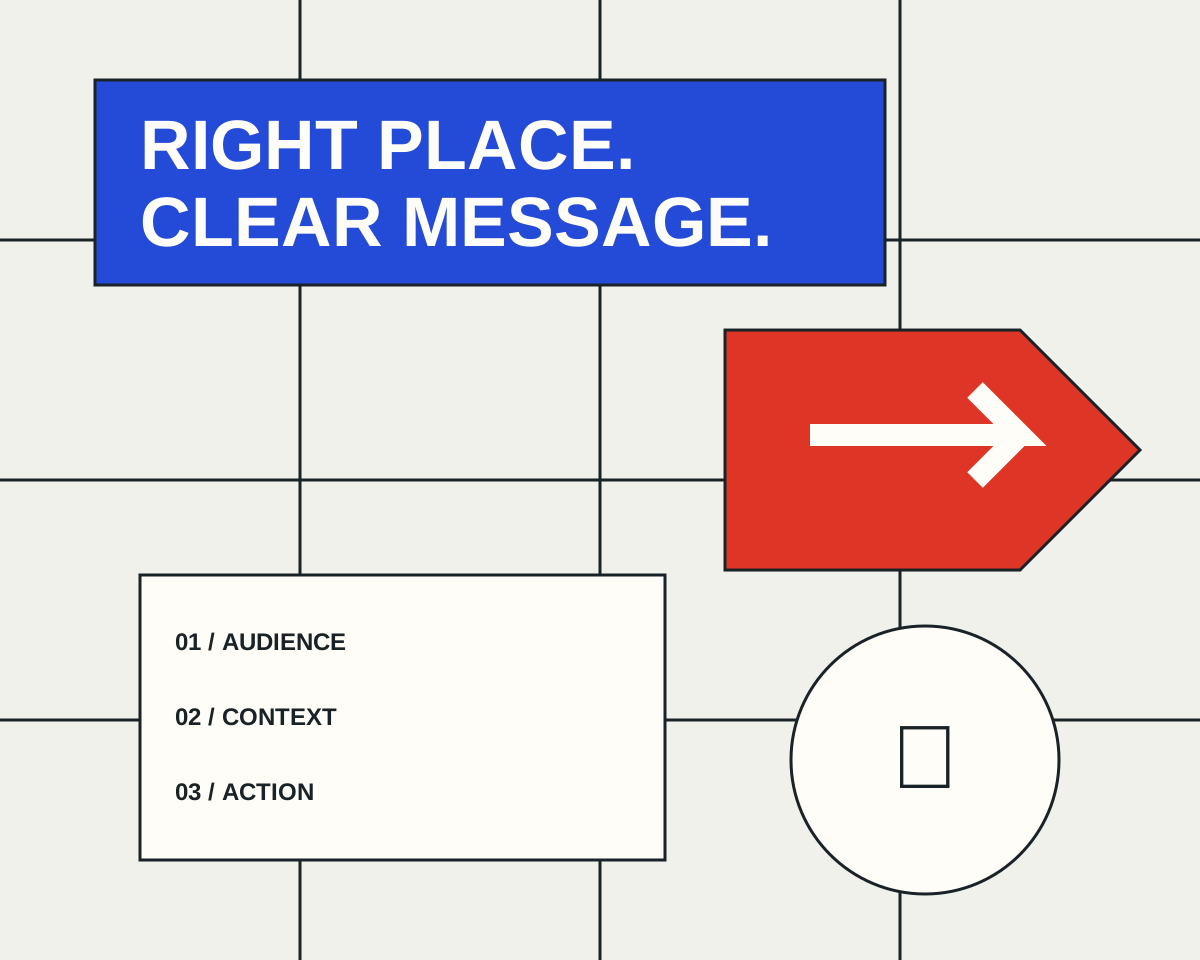
START WITH THE DECISION
A message has a purpose. Before selecting a format, outline what someone needs to know and what they can reasonably do next. These three questions establish a baseline for comparing ideas across the site.
Describe a situation, not just a demographic. Someone choosing lunch nearby needs different information from someone planning a festival visit weeks ahead.
A search result, shop window and moving vehicle create different reading conditions. Match the level of detail to the time and attention available.
Choose one understandable action. Make the destination, opening details or event information consistent wherever the message appears.
TWO WAYS INTO THE LIBRARY
Retail and restaurant messages help people decide whether a place fits their needs. Start with the offer, location and practical details before considering a memorable treatment. A clear promise needs a destination that explains it.
Read retail advertising →Explore restaurant ideas →Event communication has a deadline. Work backward from the date to consider when people need awareness, reminders and arrival information. A festival invitation and an on-site direction sign serve different purposes, even when they share a visual identity.
Plan event communication →Browse festival promotion →ONE BRIEF / CONNECTED CHANNELS
Use a concise brief to bridge physical and digital touchpoints: audience, place, message, action. Then review each format on its own terms. A sign should be legible in context; a linked page should answer the next question without making someone start again.
Consider the distance, movement, and competing visual information. Prioritize a recognizable message before adding detail.
Study outdoor displays ↗Consider how a message reads when its surface is moving or partly obscured. View the layout as a hierarchy.
Read about vehicle messages ↗CHOOSE YOUR NEXT QUESTION
Read with context. Check dates and sources before carrying a figure or example into your own plan; older articles can be useful prompts without describing today’s conditions.
PRACTICAL ANSWERS
SEO and marketing planning bridges the gap between what people need and the information they encounter. Begin by identifying a relevant audience question, then determine where to address it. Search content, local information and physical advertising can support the same goal when their details and next steps agree.
Begin with a single audience and one specific action, such as finding opening hours or checking an event date. Review the information already available about the business, then choose a topic in the local store marketing section. A focused brief is easier to review than a collection of unrelated promotional ideas.
Select based on the customer decision you aim to support. Retail messages typically help people understand a product, offer, or store visit; event messages need to communicate timing, location, and participation. If a store is hosting an event, write a shared brief and give each message a specific role.
Yes, a tangible message can guide people toward relevant online information. Keep the destination easy to recognize and make sure it answers the question raised by the sign. Check the page on a phone, especially opening details, directions and the next action, before including a link or code in artwork.
A useful brief identifies the audience, the setting, the main message and the action you want someone to take. Add practical constraints such as dates, available formats and responsibility for checking details. Separate confirmed information from assumptions so a designer or writer knows what still needs a decision.
Rely solely on the data required for the sign’s function and its viewing environment. A passing crowd has a different reading opportunity from someone standing at a counter. Test the hierarchy at a realistic distance and size, then move supporting details to a suitable page or handout where they can be read comfortably.
Use older articles as prompts for questions and creative approaches. Check publication dates and verify any time-sensitive figures, platform features or examples before using them in a plan. A historical campaign can still illustrate message structure, but its circumstances should not be treated as evidence of what will work today.
No, a guide cannot guarantee rankings, sales or attendance. Results depend on the offer, audience, execution and conditions surrounding the activity. Define what you want to learn, choose a suitable measurement method and review the evidence after the work runs. Treat examples as starting points for your own decisions.
NEXT UP
Take one audience question into your next planning session. The local marketing collection offers a place to begin connecting your message with a real setting.
Open the local marketing guidesПланирование связывает потребности аудитории с информацией, которую они находят. Оно начинается с выявления актуального вопроса клиента и определения места, где этот вопрос можно решить, будь то поисковый контент, локальные данные или физическая реклама.
Начните с определения одной целевой аудитории и одного конкретного действия, например, проверки времени работы или даты мероприятия. Оцените имеющуюся информацию о бизнесе и выберите тему в разделе локального маркетинга, так как сфокусированное краткое описание проще проверить, чем набор разрозненных идей.
Выбор зависит от решения, которое вы хотите помочь принять клиенту. Розничные сообщения помогают понять продукт или предложение, тогда как сообщения о мероприятиях должны передавать время, место и условия участия. Если магазин проводит мероприятие, создайте единое краткое описание, но дайте каждому сообщению свою конкретную роль.
Да, физическое сообщение может направлять людей к соответствующей онлайн-информации. Важно, чтобы целевая страница была легко узнаваема и отвечала на вопрос, поднятый вывеской. Перед добавлением ссылки или кода в макет проверьте, как страница выглядит на телефоне, особенно разделы с часами работы, маршрутами и следующим шагом.
